
Mahindra Thar: First 1,000 km Experience and Review
Over the first 1,000 km, most Mahindra Thar owners report a firm but confidence inspiring ride, strong low end torque and real world fuel economy of roughly 9–13 km/l in the city and 12–15 km/l on the highway, depending on engine and driving style. Common early observations include excellent off road grip some cabin road noise, a comfortable driving position and a handful of minor fit and finish niggles rather than major mechanical issues.
Introduction
The first 1,000 kilometres with any new vehicle tell you far more than a 20 minute test drive ever can. This is the distance where the new car excitement settles down, the seat starts to feel familiar and small quirks good and bad begin to surface. For the Mahindra Thar, a body on frame SUV built as much for green laning as for daily commuting, this milestone matters even more, because it’s the point where buyers find out whether the rugged persona holds up once the vehicle is doing school runs, highway stints and the occasional muddy trail.
This article is built from verified Mahindra Thar specifications, official ARAI/manufacturer figures and recurring patterns reported across multiple real owners on forums like Team BHP and review platforms like CarWale, CarDekho and Autocar India. Where numbers vary between sources which they do, since real world mileage and comfort perception depend heavily on driving style, load and road conditions that range is stated honestly rather than picking one number and presenting it as universal. By the end, you’ll know exactly what to expect from a Thar’s first 1,000 km: city driving, highway cruising, fuel economy, ride quality, off road behaviour, cabin comfort and the first service.

First Impressions After 100 km
The first 100 km with the Thar is dominated by two things: the high, commanding seating position and the sheer physical presence of the SUV in traffic. Owners consistently describe the initial drive as confidence inspiring the elevated driving position gives excellent visibility over most traffic and the ladder frame construction makes the vehicle feel solid rather than flimsy over the first few speed breakers and potholes.
Early observations also tend to include:
A heavier, more deliberate steering feel compared to a typical hatchback or sedan, which some drivers need a short adjustment period for, especially during tight parking manoeuvres.
Noticeably punchy low end torque, particularly on the diesel variants, which makes the Thar feel eager off the line in city traffic.
A learning curve around the Thar’s long front overhang several owners note they initially misjudge the front end in tight spots, since most other cars require watching the rear instead.
One Day with the Mahindra Thar: A Complete Driving Diary (City, Highway and Off Road)
Mahindra Thar City Driving Experience
City driving is where the Thar’s dual personality becomes clear. The high ground clearance and short wheelbase (on the 3 door) make it genuinely easy to place in traffic and manoeuvre around obstacles and the torquey engines mean overtaking auto rickshaws and merging into gaps requires very little planning.
The trade off is turning radius and low speed steering weight. The long front overhang means U turns and multi point parking need more space and more attention than a typical hatchback and the unassisted feel on lower trims can make prolonged stop start traffic mildly tiring on the wrists over a full commute.

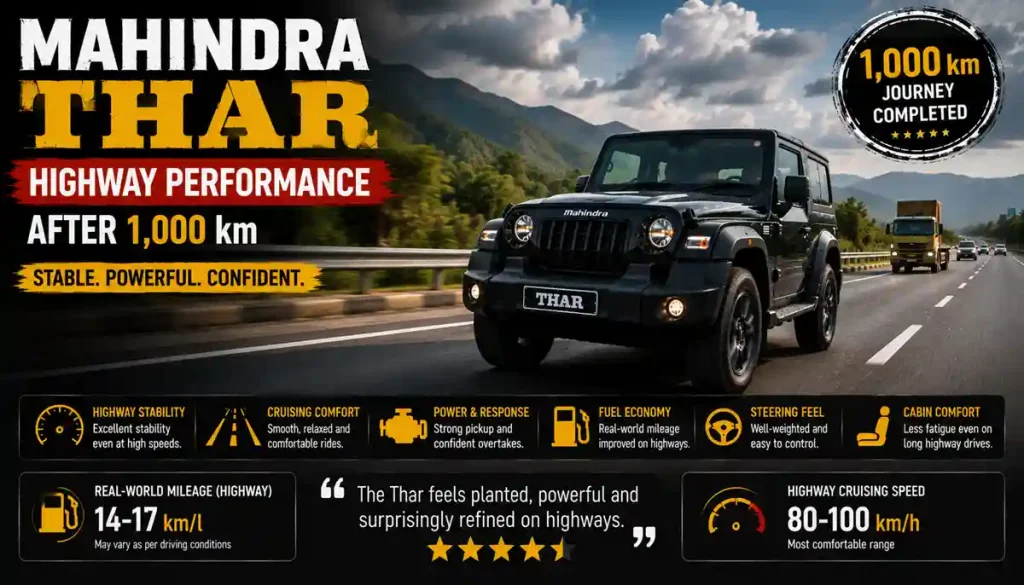
Highway Performance After 1,000 km
Highway cruising is consistently reported as one of the Thar’s stronger suits after the first few hundred kilometres. The larger diesel and turbo petrol engines settle into triple digit cruising speeds without feeling strained and the torque on tap makes overtaking on two lane highways quick and confident rather than requiring multiple downshifts.
Where owners note a compromise is wind and road noise at higher speeds a byproduct of the boxy, off road focused body shape and a degree of body movement over highway expansion joints that’s more noticeable than in a monocoque SUV of similar size. Neither is described as a dealbreaker but both are worth setting expectations for if you’re moving from a sedan or crossover.
Mahindra Thar Fuel Economy Experience
Fuel economy is one of the most asked questions about the first 1,000 km and it’s also where claimed and real world figures diverge the most.
Ride Quality and Suspension Performance
The Thar uses a double wishbone front suspension and a multi link rear setup with coil springs, sitting on a ladder frame chassis hardware built primarily for off road articulation rather than tarmac comfort. On the road, this translates to a ride that’s noticeably firmer than a typical monocoque SUV, especially over sharp, small bumps at low speed. At higher speeds and over larger undulations, the suspension settles down and feels planted and confident.
Mahindra’s mid life suspension retune on the 2025 facelift has been reported by several sources to improve on road comfort compared to the original 2020 Thar, though the underlying hardware and therefore the fundamentally firm character remains unchanged. If ride comfort on broken city roads is a top priority, it’s worth test driving the exact variant you’re considering rather than assuming all Thar trims ride identically.

Steering and Handling Experience
Steering feel is generally described as accurate once moving, with predictable behaviour through corners for a vehicle of this height and weight. Body roll is present expected in a tall, ladder frame SUV but not excessive at normal road speeds. At low speeds and while parking, the steering can feel heavier than expected, particularly on non power assisted lower variants, though most trims sold today come with power steering as standard.
Engine and Transmission Performance
Three engine options are relevant to a first 1,000 km experience:
Gear shifts on the manual variants are reported as slightly notchy but mechanically reassuring rather than imprecise, while the 6 speed torque converter automatic is described as smooth in daily driving, though not as quick shifting as a dual clutch unit a reasonable trade off given the Thar’s off road focus, where a torque converter is generally more durable than a DCT.

Braking Performance and Safety
Braking performance is consistently rated as strong and predictable, with the Thar carrying a 4 star Global NCAP safety rating in current testing. RWD variants use a brake locking differential in place of a mechanical locking diff, which affects off road behaviour more than everyday braking feel. In daily driving, pedal feel is firm and progressive rather than overly sharp or spongy.
Mahindra Thar Off Road Experience
Off road capability remains the Thar’s clearest differentiator and it’s frequently the reason buyers choose it over more road biased SUVs in the first place. The 4WD variants (available with the 2.2 litre diesel and 2.0 litre petrol) come with a proper low range gearbox and a mechanical locking differential, while ground clearance and generous wheel articulation help the Thar handle mud, loose gravel and rocky trails with confidence well beyond what most owners will actually need in their first 1,000 km.
Hill descent control and hill start assist add a safety margin for less experienced off road drivers and multiple owner reports specifically highlight the Thar’s ability to shrug off rutted, broken or unpaved roads that would be genuinely uncomfortable in a regular hatchback or sedan.
Driving on Rough and Broken Roads
This is arguably where the Thar’s firm suspension pays off rather than costs. Broken tarmac, unmarked speed breakers and gravel patches common on Indian roads are absorbed with far more composure than in most passenger cars and the higher ground clearance means owners report far fewer scrapes or bottom outs on rutted village roads and unfinished highway stretches.
Cabin Comfort on Long Drives
Seat comfort receives generally positive feedback for shorter and medium trips, with a driving position that many owners find genuinely comfortable even after a few hours behind the wheel. Two areas come up repeatedly in longer drive feedback:
Cabin noise: wind and road noise increase noticeably above highway cruising speeds, more so than in monocoque SUVs of similar size.
Rear seat space: on the 3 door Thar, rear seat access and space are tighter than a typical family SUV a known trade off of the compact, off road first body style. Buyers prioritising rear seat comfort should specifically check the 5 door Thar Roxx variant, which addresses this directly.

Interior and Infotainment Experience
The 2025 facelift brought a larger 10.25 inch touchscreen, along with quality of life additions like a rear wiper/washer and rear camera that earlier Thar buyers had to live without. Android Auto and Apple CarPlay support are standard on the touchscreen equipped variants and most owners find the system responsive enough for daily use, though not as slick as infotainment units from more road focused SUV rivals.
Tire Performance and Road Grip
Stock all terrain tyres are tuned to balance on road grip with off road traction, which means they perform well on gravel, mud and loose surfaces but generate more road noise and slightly less outright grip on smooth tarmac compared to dedicated highway tyres. This is a deliberate engineering trade off rather than a flaw and it’s consistent with the Thar’s off road first positioning.
Maintenance During the First 1,000 km
The first service milestone (typically scheduled around 1,000 km or roughly one month, depending on the dealership) is mainly a routine inspection checking fluid levels, oil, filters, tyre condition and brake components, plus resolving any minor niggles reported by the owner. Most owners describe this first service as quick and uneventful, provided any issues are flagged clearly in advance.

Service and Inspection Experience
Service experience varies by dealership rather than being uniform across the ownership base a pattern common to most mass market brands in India. Owners who research their local service centre’s reputation in advance and document any pickup time niggles clearly, generally report smoother first service experiences than those who don’t.
Problems or Issues Found
Across multiple independent ownership reports, issues within the first 1,000 km tend to be minor rather than major: small rattles (commonly traced to boot area fittings or loose bolts), occasional infotainment lag or missing convenience features on lower trims (such as a rear wiper on pre facelift models, since resolved in the 2025 update). Genuinely serious mechanical failures within this early distance are rarely reported, though as with any vehicle individual experiences can vary and this article cannot verify that every unit will match this pattern.
What I Like About the Thar

What Could Be Better
Is the Mahindra Thar Good for Daily Use?
For buyers who primarily drive in the city or on highways and only occasionally venture off road, the Thar works well as a daily driver, provided the firmer ride and larger turning radius are acceptable trade offs for its capability and road presence. Buyers who need maximum rear seat space, the smoothest possible ride or best in class city mileage may find a monocoque SUV or the 5 door Thar Roxx, a better daily use fit.
Overall Experience After 1,000 km
By the 1,000 km mark, the pattern across most Thar ownership reports is consistent: strong engine character, genuine off road ability, a firm but composed ride and a handful of minor niggles rather than serious mechanical problems. It’s not the most refined choice for buyers who only ever drive on smooth city roads but for anyone who values capability and road presence alongside daily usability, the early ownership experience is generally described as satisfying rather than compromised.
Long Term Ownership Expectations
Looking beyond the first 1,000 km, owners typically report that fuel economy stabilises (and often improves slightly) as the engine loosens up, service costs remain broadly in line with other Mahindra SUVs and the core off road hardware continues to be a strong point through years of ownership. As with any vehicle, keeping to the recommended service schedule and addressing minor niggles early tends to prevent them from becoming bigger issues later.
Conclusion
The first 1,000 km with a Mahindra Thar sets clear expectations for what ownership looks like going forward: strong engine character, genuine off road ability, a firm but confidence inspiring ride and generally minor rather than major early issues. It rewards buyers who actually want the rugged, go anywhere character the Thar is built around, while buyers chasing maximum daily use comfort or rear seat room may be better served by the 5 door Thar Roxx or a monocoque SUV alternative.
If you’re a new or upcoming Thar owner, keep a simple log of your city and highway mileage during these first 1,000 km, note down any rattles or niggles as they appear and bring that list to your first service appointment it’s the single easiest way to make sure small issues get resolved early rather than becoming bigger ones later.