Mahindra Thar vs Creta Hyundai: 7 Shocking Differences You Must Know
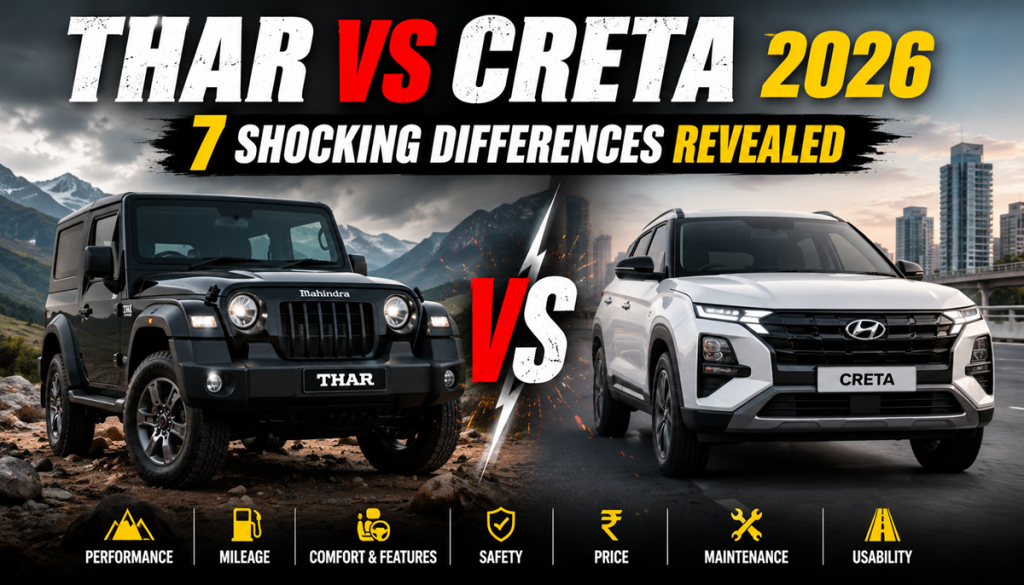
Imagine standing in a showroom, torn between two very different machines. On your left, the rugged and bold Mahindra Thar a vehicle built for mud, mountains and adventure. On your right, the sleek and polished Hyundai Creta a family favorite designed for smooth highways and city roads. Both carry an SUV badge, yet they speak completely different languages.
This is probably the most debated Thar vs Creta question across Indian car forums right now. And in 2026, with both vehicles receiving exciting updates, choosing between them has never been harder or more interesting.
I’ve driven both extensively across city streets, mountain passes and off road trails. This guide gives you a clear, honest and detailed breakdown so you can finally decide which SUV is truly right for your life. Let’s dive in.
Overview of the Mahindra Thar SUV
The Mahindra Thar is a legend in India’s automotive world. Originally inspired by the classic Jeep, the Thar has reinvented itself as a modern lifestyle SUV without losing its off road soul. The 2026 version builds on the last generation’s success and takes things up a notch.
The Thar now comes with a five door variant alongside its iconic three door version a game changer that has made it far more practical for families and long trips. It sits on a ladder frame chassis, uses a 4×4 drivetrain and features a solid rear axle all hallmarks of a proper off roader.
But what truly makes the Thar special is its personality. Every Thar owner will tell you it’s not just a car, it’s an experience. People wave at you on the road. You feel every bump, every incline and every trail. It demands your attention and rewards you with adventure.
Overview of the Hyundai Creta SUV
The Hyundai Creta needs no introduction. It has been one of the best selling SUVs in India for several years running and the 2026 model continues that trend with a sharper design, a more feature packed cabin and a wider range of powertrain options.
The Creta is what car experts call an urban SUV. It’s designed to handle Indian city traffic with confidence, offer comfortable long distance highway cruising and seat five people in genuine comfort. It comes with both petrol and diesel engine options, plus an electric variant, giving buyers great flexibility.
Hyundai has poured serious investment into the Creta’s interior quality and technology. The 2026 model features a panoramic sunroof, a large touchscreen infotainment system, ventilated front seats and advanced safety features that were once reserved for premium sedans.
Mahindra Thar vs Jimny: Which 4×4 SUV Wins in 2026?
Engine and Performance Comparison
Let’s talk engines because this is where the Mahindra Thar vs Creta Hyundai 2026 battle gets really interesting. Both offer multiple powertrains but they serve very different purposes.
| Specification | Mahindra Thar 2026 | Hyundai Creta 2026 |
| Petrol Engine | 2.0L mStallion Turbo (150 bhp) | 1.5L Turbo GDi (160 bhp) |
| Diesel Engine | 2.2L mHawk (130 bhp) | 1.6L CRDi (116 bhp) |
| Torque (Diesel) | 300 Nm | 250 Nm |
| Torque (Petrol) | 320 Nm | 253 Nm |
| Gearbox Options | 6MT / 6AT | 6MT / IVT / 7DCT |
| Drive Type | 4×4 (Part Time) | FWD / AWD (select) |
| 0–100 kmph | ~11.5 sec (petrol) | ~9.5 sec (turbo petrol) |
| Top Speed | 160 kmph | 185 kmph |
| Electric Option | No | Yes (Creta EV) |
The Thar’s diesel engine produces a beefy 300 Nm of torque extremely useful when crawling through rocky trails or climbing steep off road tracks. However, the Creta’s turbo petrol delivers sharper acceleration and feels more refined on highways.
For city driving, the Creta’s engine options feel more naturally suited. The Thar, while powerful, has a slightly longer gear throw and stiffer clutch in manual form, which can feel tiring in stop and go traffic.

Off Road Capability vs City Driving
This is the defining question in any Thar vs Creta comparison: where are you actually going to drive this thing?
Comfort and Interior Features
Step inside both vehicles and you immediately feel two completely different philosophies.
Safety Features Comparison
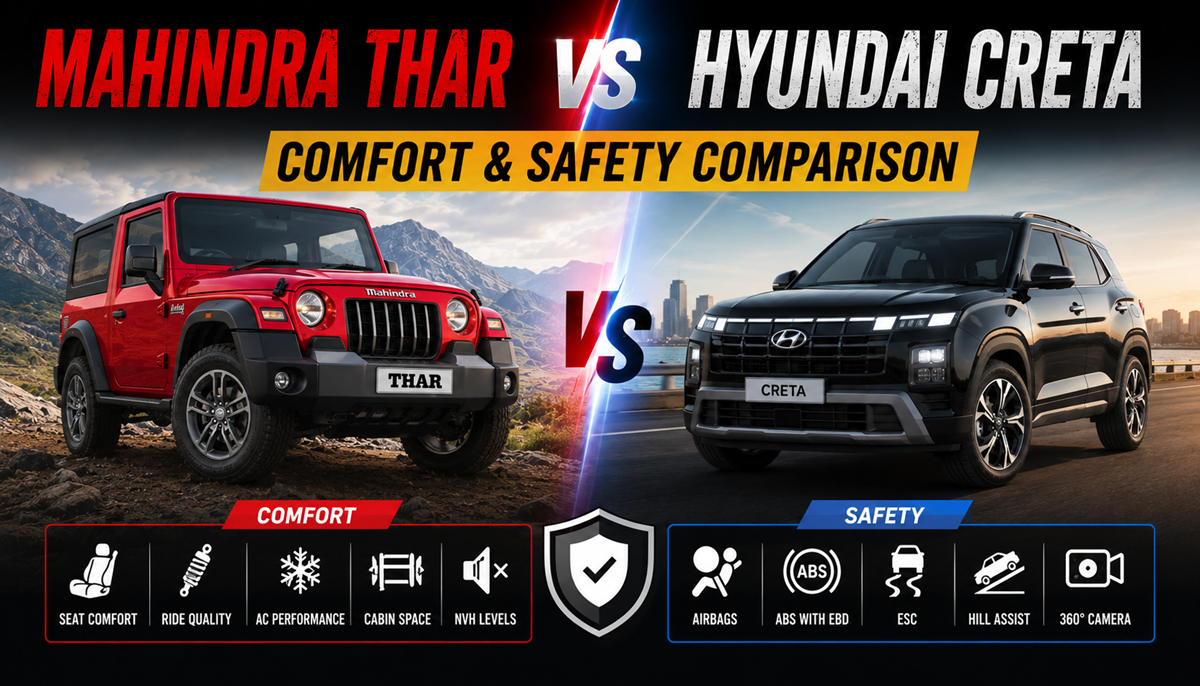
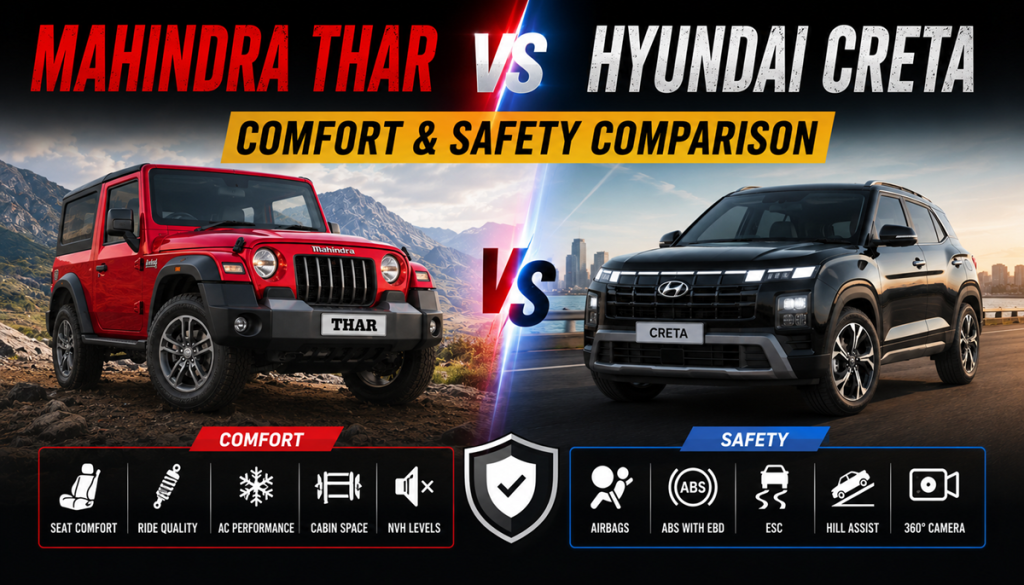
Safety is non negotiable and both these SUVs bring solid safety credentials to the table though the Creta has a clear edge in modern driver assistance features.
The Hyundai Creta’s 2026 model is equipped with six airbags as standard, ABS with EBD, Electronic Stability Control (ESC), Hill Start Assist, rear parking camera with sensors and on higher trims, a 360 degree camera view. It also offers Level 2 ADAS (Advanced Driver Assistance System) features including forward collision warning, lane departure alert and adaptive cruise control.
The Mahindra Thar offers four airbags, ABS with EBD, roll over mitigation, traction control and hill descent control. Its safety suite is adequate but not as advanced as the Creta’s driver assistance offerings. That said, the Thar’s structural robustness and 4×4 drivetrain add an inherent level of safety in tricky off road conditions that no number of electronic aids can fully replace.
| Safety Feature | Mahindra Thar | Hyundai Creta |
| Airbags | 4 (standard) | 6 (standard) |
| ABS + EBD | Yes | Yes |
| Electronic Stability Control | Yes | Yes |
| Hill Start Assist | Yes | Yes |
| Hill Descent Control | Yes | No |
| 360° Camera | No | Yes (top trim) |
| ADAS Level 2 | No | Yes |
| Traction Control (4×4) | Advanced (4WD) | Basic |
| Roll Over Mitigation | Yes | No |
Mileage and Fuel Efficiency
In real world Indian driving conditions, here is how the two SUVs stack up on fuel efficiency a factor that significantly affects long term ownership costs.
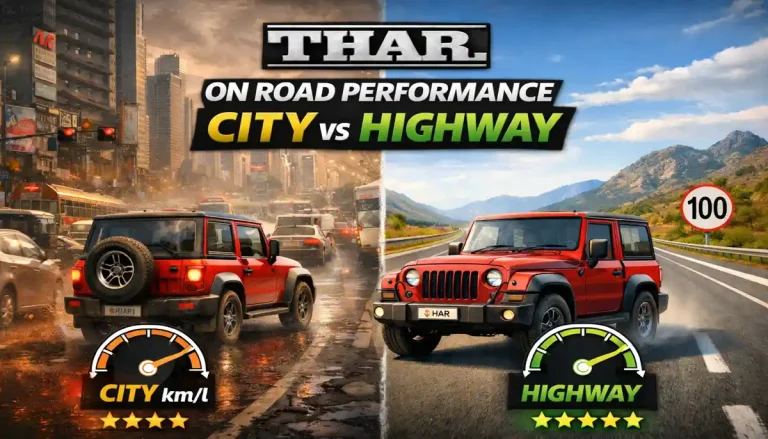
The Hyundai Creta diesel delivers approximately 18–20 kmpl on highways and 13–15 kmpl in city conditions. Its petrol turbo returns around 14–16 kmpl on highways. These are strong numbers for an SUV of this size and capability.
The Mahindra Thar, by contrast, is a heavier, more capable machine and fuel efficiency reflects that. The Thar diesel returns approximately 15–17 kmpl on highways and 10–12 kmpl in city traffic. On off road terrain (where 4L mode is engaged), mileage can drop further to 8–10 kmpl.
| Mileage (Claimed / Real World) | Mahindra Thar | Hyundai Creta |
| Diesel — Highway | ~16 kmpl | ~19 kmpl |
| Diesel — City | ~11 kmpl | ~14 kmpl |
| Petrol — Highway | ~13 kmpl | ~15 kmpl |
| Petrol — City | ~10 kmpl | ~13 kmpl |
| Off Road (4L mode) | ~8–9 kmpl | N/A |
| Fuel Tank Capacity | 57 L | 50 L (but better range) |
If daily commuting and fuel savings are your priority, the Creta wins comfortably here. The Thar is not a fuel sipping machine it trades efficiency for raw capability and character.
Price Comparison in India 2026
Price is often the first filter buyers apply and both these SUVs overlap in a surprisingly tight range which is what makes the comparison so relevant.
| Variant Type | Mahindra Thar (Ex Showroom) | Hyundai Creta (Ex Showroom) |
| Base Variant | ₹11.35 Lakh | ₹11.00 Lakh |
| Mid Variant | ₹14.50 Lakh | ₹15.00 Lakh |
| Top Variant | ₹17.60 Lakh | ₹20.15 Lakh |
| Starting On Road (Delhi approx.) | ~₹13.5 Lakh | ~₹13.0 Lakh |
| Insurance (Annual approx.) | ₹35,000–₹45,000 | ₹30,000–₹40,000 |
| Annual Maintenance (approx.) | ₹20,000–₹28,000 | ₹15,000–₹22,000 |
| Resale Value (3 year avg.) | Strong (70%+) | Good (65%+) |
The Thar’s resale value is genuinely outstanding especially in popular colours and configurations. Many used Thars sell at prices close to their original purchase value, which is quite rare in the Indian market. The Creta also holds its value well, given Hyundai’s strong brand reputation and reliable service network.
Head to Head Score: At a Glance
| Detailed | Mahindra Thar (Rating out 10) | Hyundai Creta (Rating out 10) |
| Off Road Ability | 9 | 3 |
| City Comfort | 4 | 9 |
| Fuel Efficiency | 4 | 9 |
| Interior Features | 3 | 9 |
| Safety Tech | 5 | 8 |
| Value for Money | 7 | 7 |
| Road Presence | 9 | 4 |
Mahindra Thar vs Force Gurkha: 7 Shocking Differences in the Ultimate 2026 Off Road King Test
Which SUV is Better for You?
This is the big question and the honest answer is that there is no universal winner. Each SUV wins for a specific kind of buyer. Let’s break it down clearly.
My Personal Takeaway
After spending considerable time with both vehicles on Indian roads, my honest opinion is this the Creta is the smarter everyday purchase and the Thar is the more exciting life choice.
If you asked me what to buy for your family as the only vehicle, I’d say go with the Creta without hesitation. It’ll keep everyone happy, save you fuel money and handle everything from school runs to Goa road trips with equal grace.
But if you have even a small spark of adventure in you if mountain roads excite you and the thought of driving through a river makes you smile the Thar will give you memories that no feature list can replace. Buy it for what it is: a legend on four wheels.
In the end, both the Mahindra Thar vs Creta Hyundai are exceptional vehicles in their own right. The question isn’t which is better it’s which one is right for YOU.