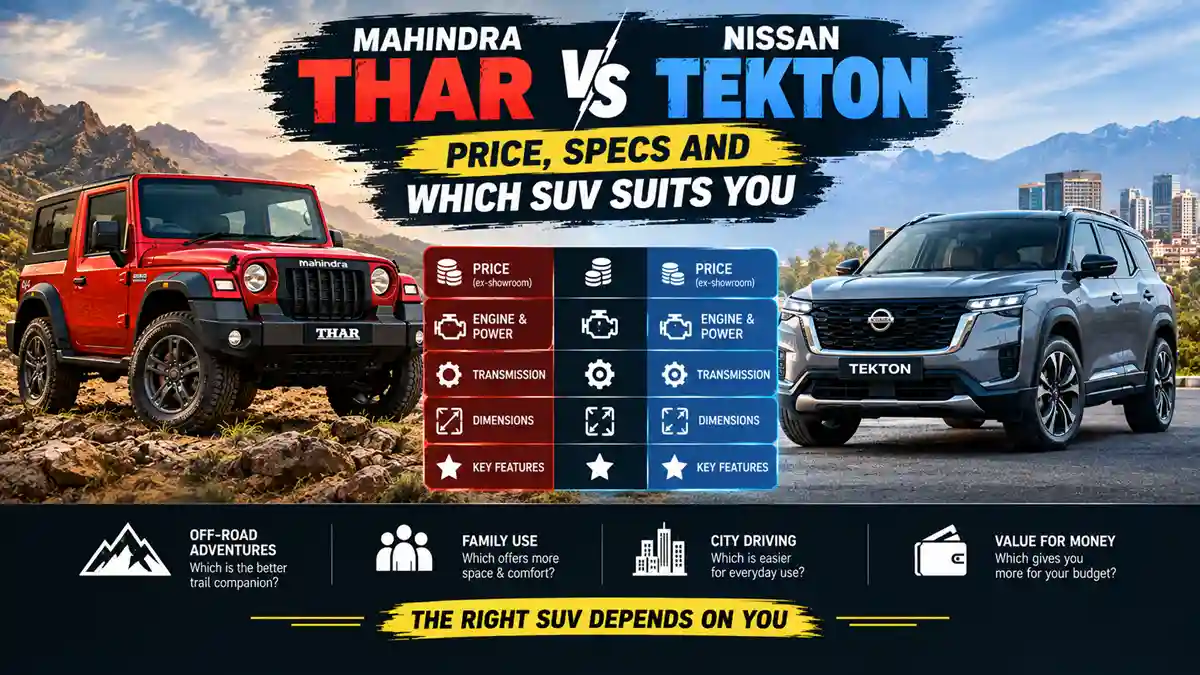
Mahindra Thar vs Nissan Tekton: Price, Specs and Which SUV Suits You
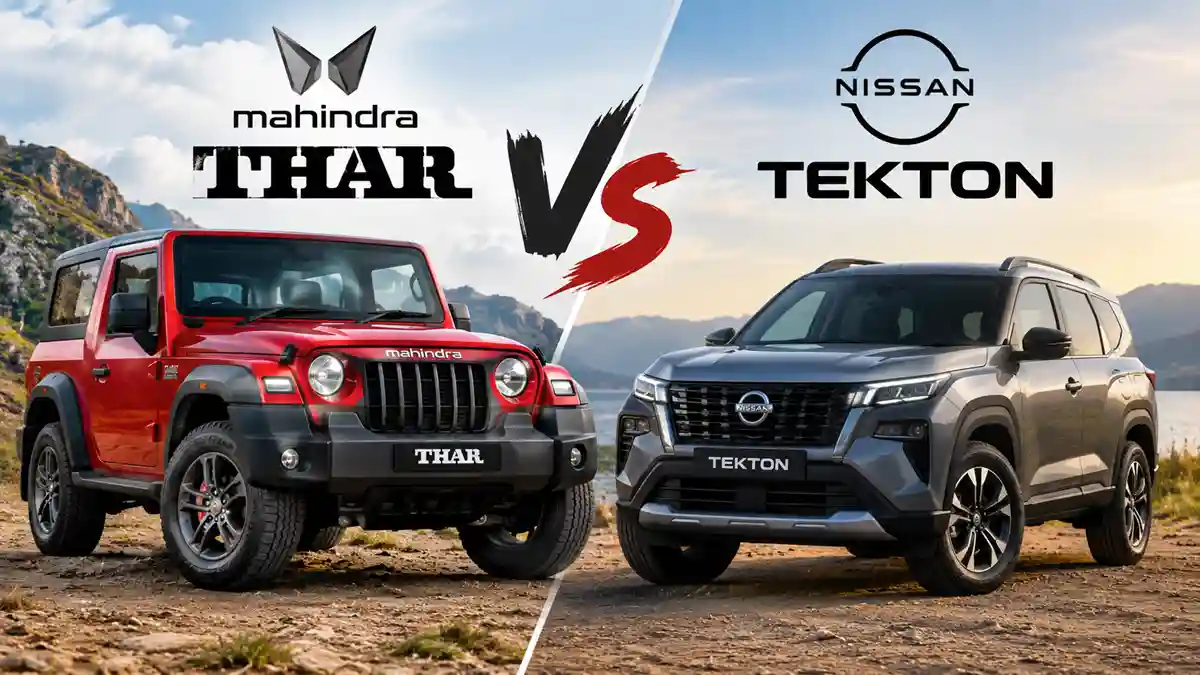
Two SUVs, nearly identical price tags, completely different jobs. That is the honest summary of Mahindra Thar vs Nissan Tekton and it is exactly why so many buyers end up stuck between them.
The confusion is understandable. The Nissan Tekton launched in India in July 2026 at ₹10.49 lakh (ex showroom), rising to ₹18.59 lakh for the top Tekna+ variant, which lands almost on top of the Thar’s price band. Both look rugged. Both carry high ground clearance. Both are sold as SUVs. But one is a body on frame 4×4 built around off road hardware and the other is a front wheel drive family crossover built around comfort and features.
This comparison breaks down price, engines, drivetrain, dimensions, mileage, safety and features using verified manufacturer and specification data, then tells you plainly which buyer each SUV is built for.
Quick Answer: Mahindra Thar vs Nissan Tekton
The Mahindra Thar is a three door, four seat ladder frame 4×4 built for off roading, with 226mm ground clearance and a low range transfer case. The Nissan Tekton is a five door, five seat front wheel drive family SUV with stronger safety credentials, more features and a far bigger boot. Choose the Thar for terrain, the Tekton for daily driving.
Mahindra Thar vs Nissan Tekton: Price Comparison
Pricing is where the two overlap most closely, which is precisely what creates the cross shopping.
The Mahindra Thar is listed at roughly ₹10.32 lakh to ₹18 lakh (ex showroom) as of September 2026, depending on engine, drivetrain and trim. The Nissan Tekton spans ₹10.49 lakh to ₹18.59 lakh (ex showroom) across 12 variants and six trim levels: Visia, Visia+, Acenta, N Connecta, Tekna and Tekna+.
Two caveats worth knowing before you compare sticker prices:
Different listings quote slightly different Thar top end prices (₹17.80 lakh to ₹18 lakh) because they track different variant sets and price revisions. Always confirm the current on road price with your dealer.
The Thar’s entry price buys a very different vehicle. The base AXT is a rear wheel drive 1.5 litre diesel hard top with basic equipment. Proper 4×4 capability sits in the LXT variants near the top of the range, so a genuinely off road ready Thar costs meaningfully more than ₹10.32 lakh.
The Tekton’s base Visia, by contrast, already includes six airbags, ABS with EBD, ESC, traction control, hill start assist and ISOFIX mounts as standard.
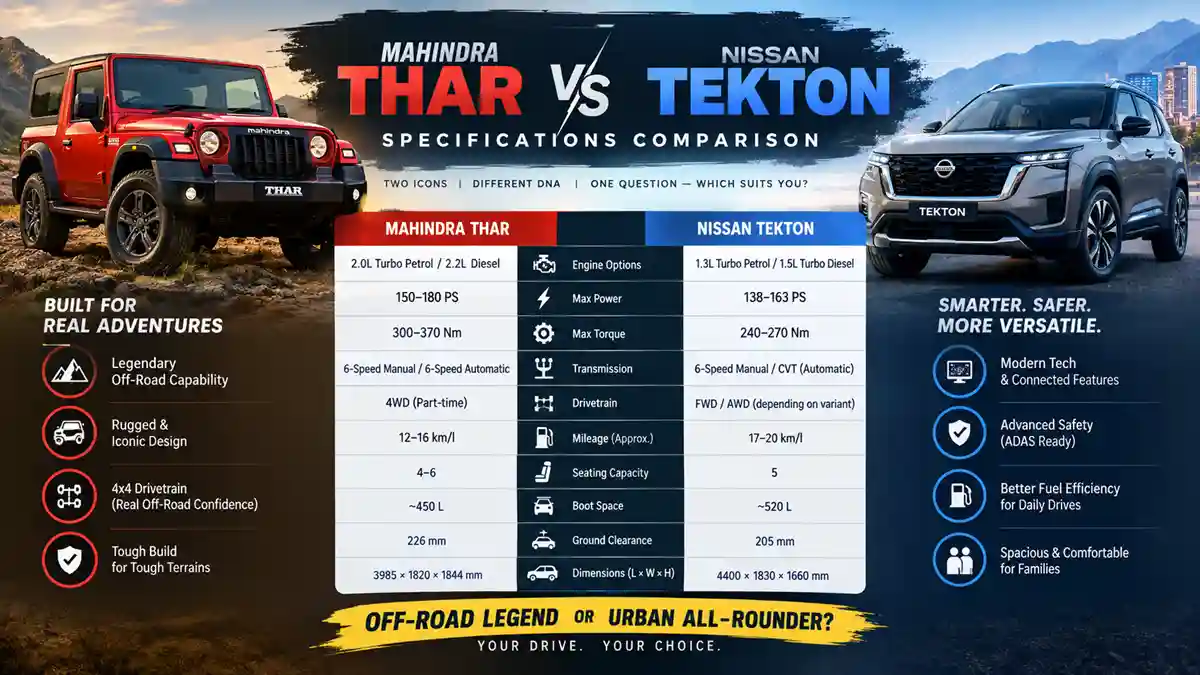
Mahindra Thar vs Nissan Tekton: Specifications at a Glance
| Specification | Mahindra Thar (3-door) | Nissan Tekton |
| Body style | 3-door, 4-seat | 5-door, 5-seat |
| Chassis | Ladder frame | Monocoque |
| Engines | 1.5L diesel (118hp), 2.2L diesel (130hp), 2.0L turbo-petrol (150hp) | 1.0L turbo-petrol (100hp), 1.3L turbo-petrol (163hp) |
| Peak torque | 300Nm (diesels); 300Nm MT / 320Nm AT (petrol) | 166Nm (1.0L); 280Nm (1.3L) |
| Transmissions | 6-speed manual, 6-speed torque converter | 6-speed manual, 6-speed wet-clutch DCT |
| Drivetrain | RWD or 4×4 with low range | Front-wheel drive only |
| Length × Width × Height | 3,985 × 1,855 × 1,850mm | 4,349 × 1,815 × 1,674mm |
| Wheelbase | 2,450mm | 2,657mm |
| Ground clearance | 226mm | 212mm |
| Boot space | Not officially published | 518 litres |
| Fuel tank | 45L (1.5D) / 57L | 50 litres |
| ARAI mileage | Up to 15.2kmpl | 17.8–19.4kmpl |
| Crash rating | 4-star Global NCAP | 5-star Bharat NCAP |
Thar dimension listings vary slightly by source (some quote 1,820mm width and 1,844mm height, measured differently). Figures above follow Autocar India’s specification summary.
Engine and Performance: Torque vs Turbo Petrol
The engine philosophies could not be further apart.
The Mahindra Thar offers a 1,497cc diesel (118hp), a 2,184cc diesel (130hp) and a 1,997cc turbo petrol (150hp), with six speed manual or automatic gearboxes and a choice of rear wheel drive or 4×4. The 2.0 litre mStallion petrol makes 300Nm with the manual and 320Nm with the automatic. These are low revving, torque rich engines designed to pull a heavy ladder frame vehicle up a slope at walking pace.
The Tekton takes the modern efficiency route. Entry variants use a 1.0 litre three cylinder turbo petrol making 100hp and 166Nm with a six speed manual only, while higher trims get a 1.3 litre four cylinder direct injection turbo petrol producing 163hp and 280Nm with a six speed manual or wet clutch DCT.
Off Road Capability: This Is Not a Close Contest
If off roading matters at all to you, this section decides the comparison
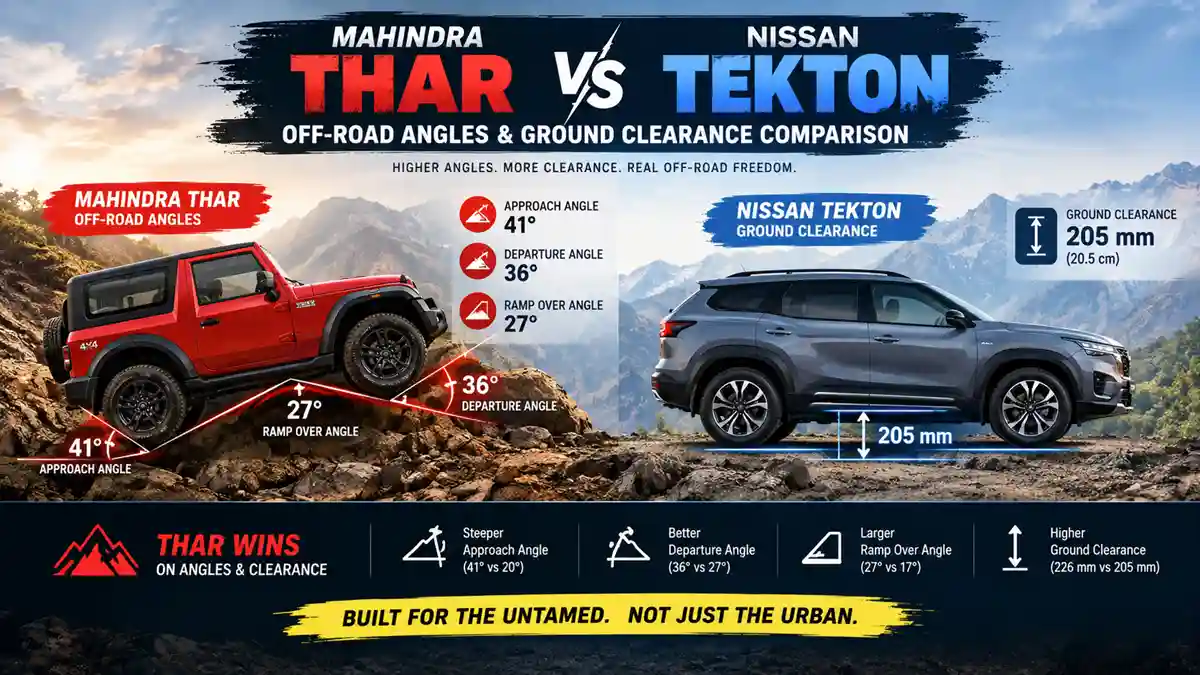
The Mahindra Thar is a genuine off roader. It offers 226mm ground clearance, a 650mm water wading depth, a 41.2 degree approach angle, 36 degree departure angle and 26.2 degree rampover angle, on a ladder frame chassis. Four wheel drive variants add a low range transfer case and a mechanical locking differential hardware that lets the vehicle crawl over obstacles, not just survive bad roads.
The Nissan Tekton is not an off roader and Nissan does not claim it is. Like its Renault Duster twin, the Tekton is front wheel drive only, even though the European Dacia Duster can be had with all wheel drive. Its 212mm ground clearance is among the highest in the midsize SUV segment, which makes it excellent over broken tarmac, speed breakers, rural tracks and monsoon flooding but that is rough road ability, not terrain capability.
The practical takeaway: the Tekton will handle 95% of what most Indian buyers actually drive over. The Thar handles the other 5% that the Tekton physically cannot.
Interior, Space and Practicality
Here the Tekton takes a decisive lead and it is structural rather than a matter of trim level.
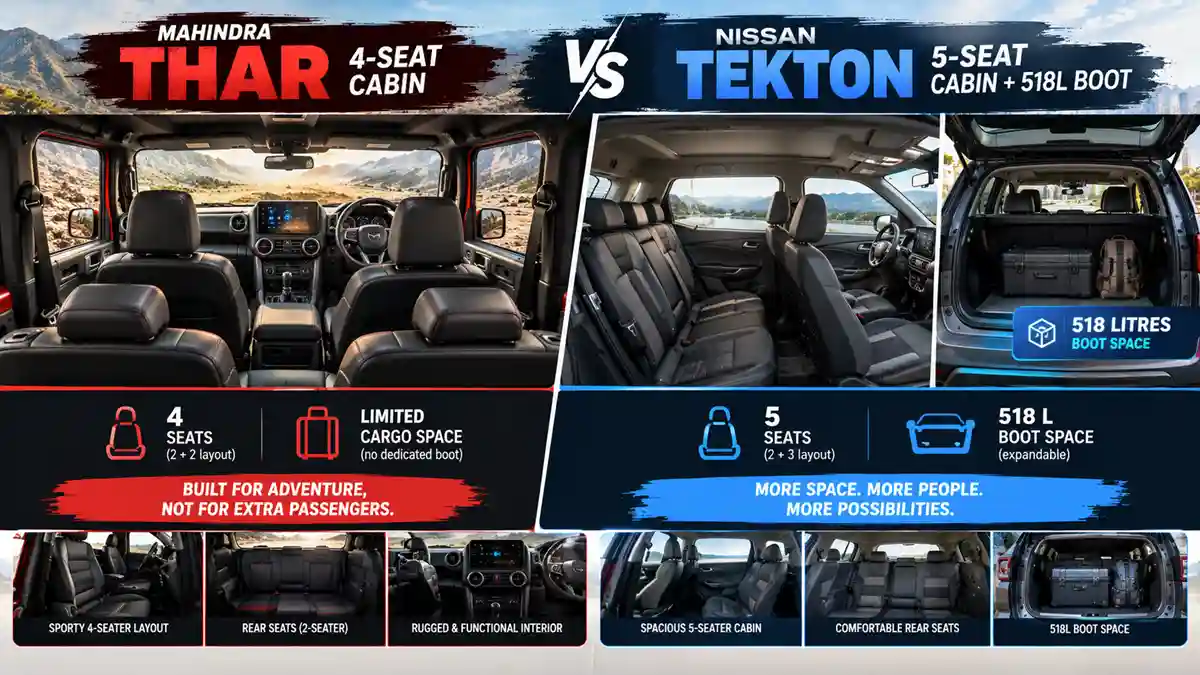
The Thar is a three door, four seat vehicle. Rear access requires folding a front seat, the rear bench is best for short trips and Mahindra does not publish an official boot capacity for the three door Thar the space behind the rear seats is genuinely small.
The Tekton is a five door, five seat family SUV with a 2,657mm wheelbase, over 200mm longer than the Thar’s. Its boot holds 518 litres with the parcel shelf in place, extends to 700 litres when loaded to the roof and expands to 1,789 litres with the rear seats folded. Autocar India rates that 518 litre figure as the highest in the midsize SUV segment.
You will occasionally see the Tekton’s boot quoted as 700 litres. Both figures are real they simply measure to different load heights. Use 518 litres for like for like comparison against rivals.
Features and Technology
The Thar received a meaningful feature update in its 2025 facelift but it remains a functional cabin rather than a plush one.
Safety Comparison
This is the clearest gap in the Tekton’s favour.
The Nissan Tekton earned a 5 star Bharat NCAP rating, scoring 30.49 out of 32 for adult occupant protection and 45 out of 49 for child occupant protection, backed by six standard airbags, a monocoque body using over 62 percent high strength steel and more than 17 Level 2 ADAS features. Depending on variant, it adds blind spot monitoring, a 360 degree camera, adaptive cruise control, autonomous emergency braking and lane keep assist.
The Mahindra Thar holds a 4 star Global NCAP rating. Its safety equipment includes dual airbags, ABS with EBD, electronic stability control, rear parking sensors, a built in roll cage, a tyre pressure monitoring system and a rear parking camera. There is no ADAS.
One important qualification: Global NCAP and Bharat NCAP use different protocols and were conducted at different times, so the star ratings are not a perfect one to one comparison. What is directly comparable is equipment six airbags and Level 2 ADAS versus two airbags and no driver assistance. On that measure, the Tekton is the safer equipped vehicle.
Mileage and Running Costs
Nissan claims ARAI figures of 19.4kmpl for the 1.0 turbo manual, 17.8kmpl for the 1.3 turbo manual and 18.5kmpl for the 1.3 turbo DCT.
The Thar’s certified figures peak at around 15.2kmpl for the efficient 1.5 litre diesel. Real world expectations matter more here: Autocar India’s advice desk puts the Thar at roughly 9–11kmpl in the city and 13–15kmpl on the highway.
Longer term ownership costs for the Tekton cannot be assessed reliably yet the SUV has only been on sale since July 2026 and no verified service cost data exists. One structural consideration is that Nissan’s dealer and service network in India is smaller than Mahindra’s, which is worth checking against your own city before buying.
Best Picnic Destinations for Thar Drivers: Mountains, Lakes, Beaches and Off Road Trails
Pros and Cons
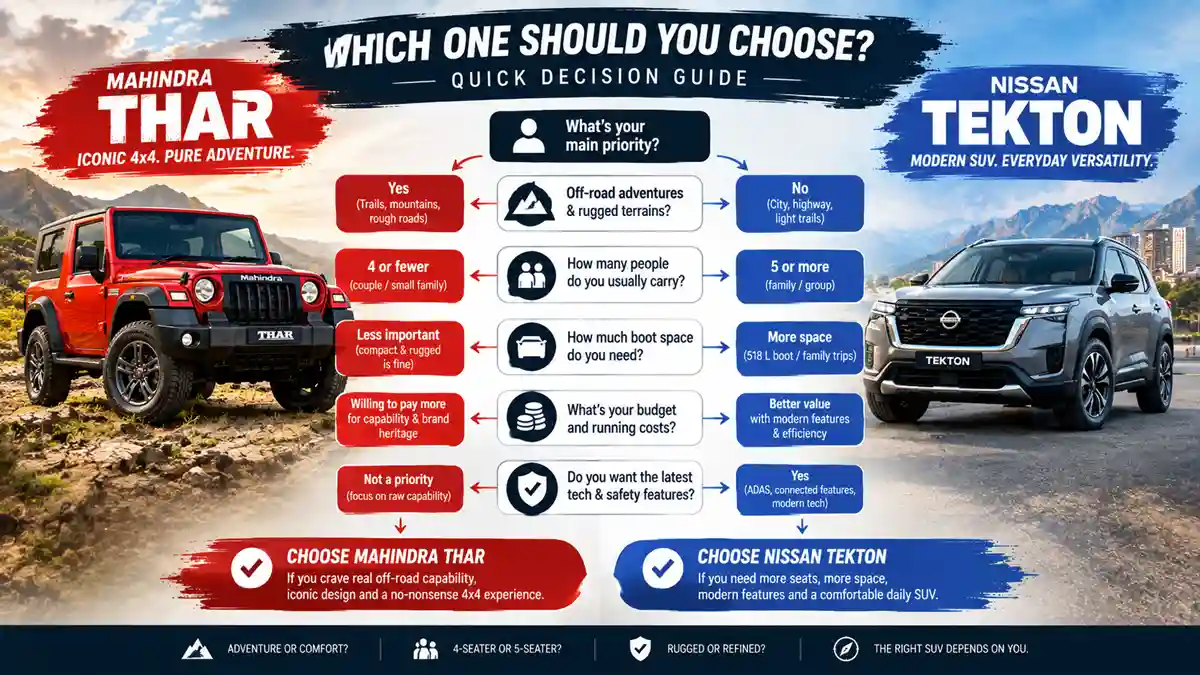
Which SUV Should You Buy?
Buy the Mahindra Thar if you off road genuinely, drive regularly on unmade or mountain roads, want a diesel, value the open top lifestyle experience and can live with four seats and almost no luggage space. A useful timing note: Mahindra is reportedly developing a further Thar facelift, so if you are not in a hurry, it may be worth asking your dealer about upcoming updates before committing.
Buy the Nissan Tekton if this is your primary family car, you carry passengers and luggage, you want maximum safety equipment for the money and your rough road is a broken city street rather than a rock trail.
If you want both Thar character with five door practicality the honest answer is that neither of these is your car. Look at the Mahindra Thar Roxx, the five door version, which keeps the 4×4 hardware and 226mm clearance while adding proper rear doors and a 447 litre boot.
The Bottom Line
Mahindra Thar vs Nissan Tekton is not really a head to head it is a fork in the road. The Thar is a purpose built 4×4 that asks you to accept real compromises in space, safety equipment and efficiency in exchange for capability and character. The Tekton is a well equipped, safe, spacious family SUV that makes no pretence of being an off roader.
Decide which of those two descriptions matches how you will actually use the vehicle 90% of the time and the choice makes itself.
Before booking either, take both on a test drive on roads you drive daily and confirm current on road pricing for your city ex showroom figures shift with taxes, insurance and dealer charges. If you are leaning toward the Thar but need more room, add the Thar Roxx to your shortlist before deciding.